Veg Thali
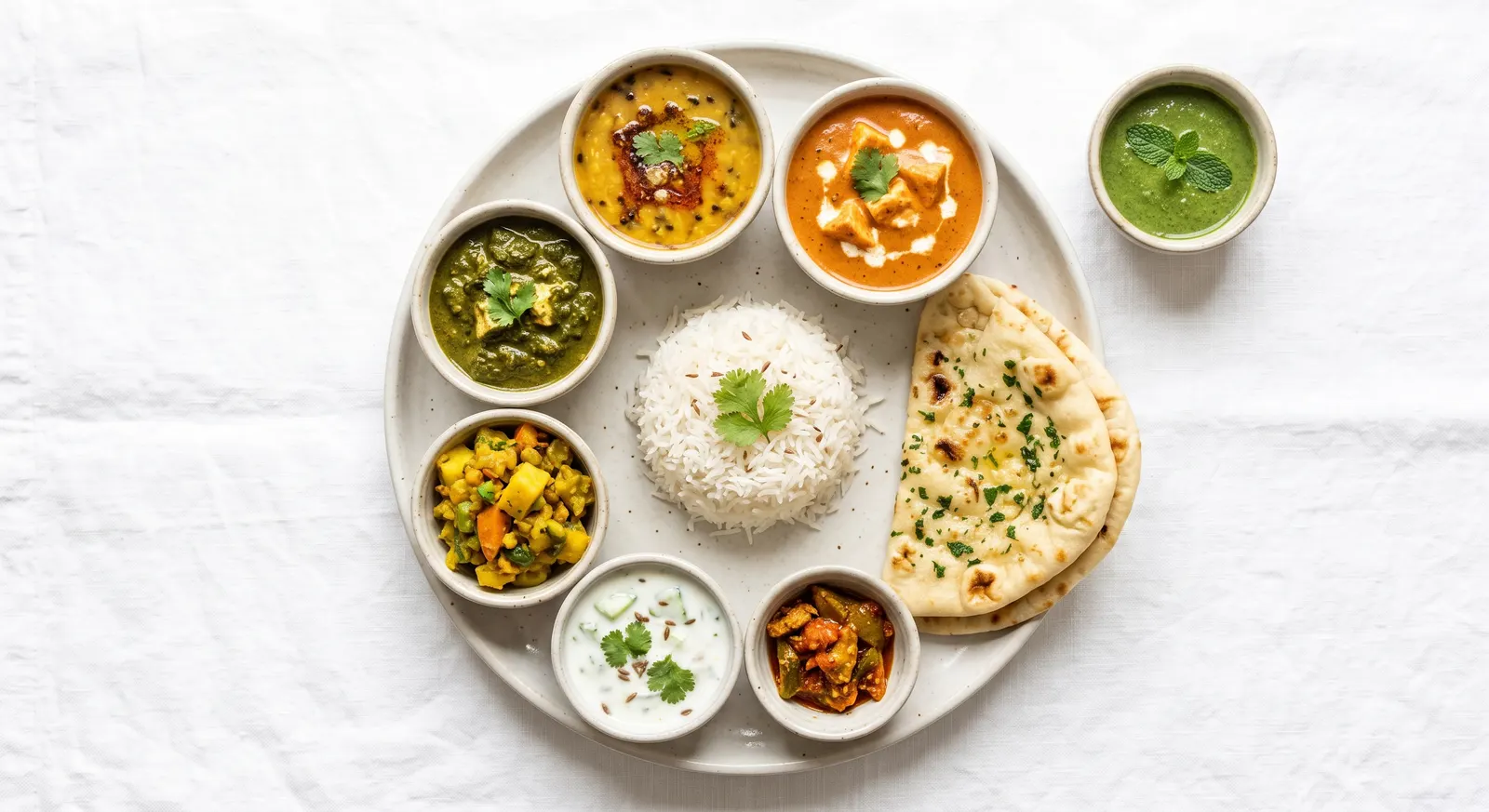
A full meal served as small bowls on one tray, built for balance rather than a centrepiece.
- Prep
- 30 min
- Cook
- 50 min
- Total
- 80 min
- Serves
- 2
- Heat
- Medium
What Veg Thali is
A thali is a complete meal on a single tray: dal, a dry vegetable, a gravied vegetable, rice, bread, yoghurt and pickle in small bowls around the rim. Nothing on it is the main course. The design is nutritional and sensory at once — each bowl covers a different taste and texture, and you are meant to move between them.
Where it comes from
The thali format appears across India and Nepal with regional contents that change every few hundred kilometres, but the logic is constant and old: the six tastes of Ayurvedic tradition — sweet, sour, salty, bitter, pungent and astringent — should all be present in a meal. In Nepal the equivalent everyday tray is dal bhat. In restaurants it is usually the best-value order on the menu.
How to eat it
Start with the plainest bowl and work towards the strongest, returning to rice between them — the tray is designed to be moved around, not eaten bowl by bowl to the bottom. Mix only a small amount of one curry into the rice at a time. Pickle is a condiment: a small smear per mouthful, not a spoonful. Yoghurt is the reset button, taken when something is too hot. In most restaurants dal and rice are refilled free, so do not over-order at the start.
Goes well with
- Masala chai afterwards
- Buttermilk or lassi alongside
- Extra papad
Ingredients
- 1 portion Cooked basmati rice
- 1 bowl Yellow dal (tadka)
- 1 bowl Seasonal dry vegetable, e.g. cabbage and pea
- 1 bowl Gravied vegetable, e.g. paneer or potato curry
- 1 small bowl Plain yoghurt
- 1 tsp Mixed pickle — Intensely salty and sour — a condiment, not a portion.
- 2 Chapati or naan
- 1 Papad
- to serve Lemon wedge and raw onion
How to cook it
1Plan the tray before you cook
Pick one dal, one dry vegetable, one wet vegetable, and a yoghurt. The rule is contrast: if the curry is rich, the dry vegetable should be light and sharp. Two rich bowls make a heavy, monotonous tray.
2Start the dal first
Dal takes the longest and holds well, so it goes on first. Simmer lentils with turmeric and salt until soft, then finish with a tempering of cumin and dried chilli in hot ghee poured over at the end.
3Cook the dry vegetable fast
A dry sabzi wants high heat and a short time — mustard seed, curry leaf and turmeric in hot oil, then the vegetable stirred until just tender. Cooked long it goes grey and loses the point of having it there.
4Build the gravied vegetable
Onion and tomato cooked down with ginger, garlic and ground spice until the fat separates, then the vegetable or paneer added and simmered briefly.
5Cook the rice and bread last
Both are best fresh. Steam the rice while the curries hold, and cook the chapati immediately before serving.
6Assemble the tray in order
Rice in the centre or at the base, bowls around the rim clockwise from mildest to strongest, pickle and lemon at the edge. Serving the pickle in a large portion rather than a spoonful is the most common mistake.
Calories and nutrition
Per serving — 1 full tray (about 650 g)
| Calories | 850 kcal |
|---|---|
| Protein | 26 g |
| Carbohydrate | 120 g |
| Fat | 27 g |
| Fibre | 14 g |
| Sodium | 1650 mg |
Approximate values for a typical restaurant portion, calculated from standard ingredient tables. Actual figures vary with the kitchen, the oil used and the portion served. Not intended as medical or dietary advice.
Where to eat Veg Thali
- NEPALICO Shibuya Ten — Tokyo
- AANGAN — Tokyo
- KHUMBILA — Tokyo
- Sekuwagaru — Tokyo
- Nepali Banshagaru Indian Curry Sakura — Tokyo
- Isora Shinjuku Higashiguchi Ten — Tokyo
- asian dining Hotpot — Tokyo
- Spice Land Tokyo — Tokyo
- Curry House Himalaya — Tokyo
- Namaste Tokyo — Tokyo
- Dal Bhat Shibuya — Tokyo
- Momo Paradise — Tokyo